Under the rules-based system of global trade, WTO members are required to give notice when new trade regulations are coming. But how much notice do you actually get?
It depends entirely on which country you are exporting to.
We mapped 24 major economies by two metrics: how quickly regulations become law after notification via the WTO, and how quickly they become enforceable. The result is a 3×3 matrix that reveals three fundamentally different regulatory cultures.
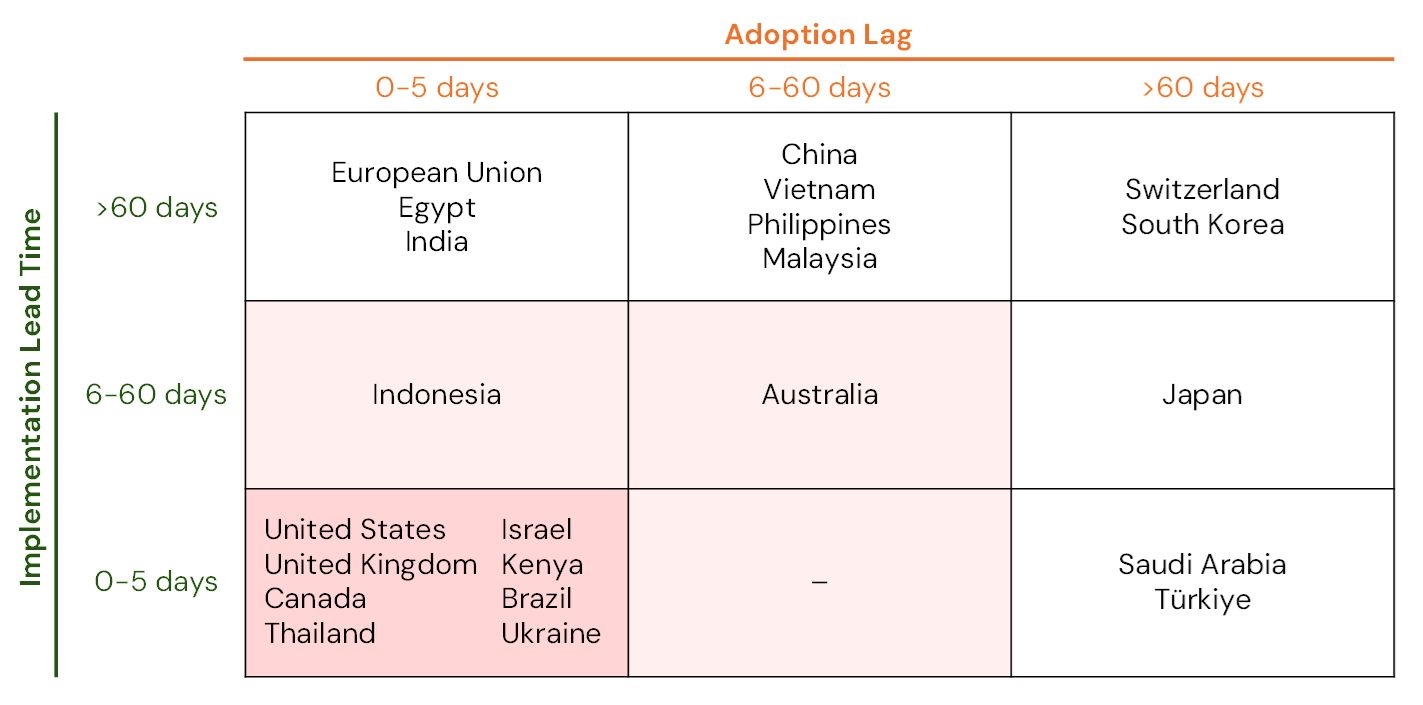
- Shock Systems (US, UK, Canada, Brazil, Kenya): near-zero notice on both adoption and enforcement. The WTO notification arrives after the regulation is already law. You cannot rely on the WTO channel in these markets — you need direct monitoring of domestic agencies.
- Pipeline Systems (China, Vietnam, Philippines, Switzerland): structured, predictable lead times. China gives a median 448 days from notification to enforcement. The WTO system works as intended here — as an early-warning mechanism.
- Hybrid Systems (Japan, Saudi Arabia, EU): long visibility on one dimension, compressed on the other. Japan shows you the regulation early, then gives you ~25 days to comply once it’s finalised. Saudi Arabia keeps regulations in draft for months, then enforces immediately upon adoption.
These are not points on a spectrum. They are structurally different regulatory cultures that demand different monitoring strategies, different resource allocation, and different escalation timelines. Treating a Shock market like a Pipeline market is how exporters get caught out by a rule that was, technically, notified all along.